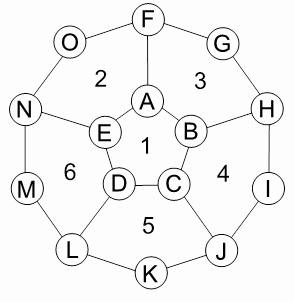
When developing something new, it is often worthwhile to look around and compare to similar things that already exist to make sure you’re not going too far off the rails — or if you are, that it is in a direction you want. In this post I do a rough comparison of my intermediate results with the Greyhawk pantheon to make sure I’m not too far out of line. I’m mildly surprised at what i find.
Category Archives: Modifications
Polyhedral Pantheons: Sanity Check
Polyhedral Pantheons: Applied
Now to show what the Polyhedral Pantheon might look like in practice. I have completed a worksheet and taken snapshots of it as I went. Overall the sheet took less than an hour to complete, including storing it at different stages and in multiple formats (the Publisher file I was editing, plus PNG ‘screenshot’ and [...]
Polyhedral Pantheons: Pathfinder Edition
The Revisited Polyhedral Pantheon Design technique still has a couple difficulties, though. First, if you use only the Revised System Reference Document (RSRD) you don’t have enough domains. The RSRD includes 22 domains — slightly more than needed if you don’t want the gods to have personal domains, but not enough to cover the shared [...]
Polyhedral Pantheon Clerics
Yesterday I Revisited Polyhedral Pantheon Design, a method of choose domains (and indirectly portfolios) for gods in D&D 3.x. It is an update to Polyhedral Pantheon Design, something I wrote several years ago. I overlooked an important part — how clerics work. Overall they are pretty similar to the core rules. The biggest change I [...]
Polyhedral Pantheons Revisited
A few years ago I wrote an article on Polyhedral Pantheon Design. I decided it was finally time to follow up on that post (especially since it predates this blog — it’s here on its original publication date to another location). I was recently looking through Pathfinder’s Advanced Player’s Guide and realized that it lends [...]
No More Fears (or Fire Damage)
Over at SeaOfStarsRPG a recent post discusses The Problem of Immunity. Specifically, how really nothing should be truly immune to any particular effect. Even paladins can be scared (they just deal with it better), and even fire elementals will burn if you manage to throw enough fire on them. In real life there really isn’t [...]
Weapon Specialization I Like: FantasyCraft
In response to Beedo’s question about using weapon specialization in D&D, I said I don’t like using weapon specialization in D&D because I find it useful, but boring. “Useful and boring”… well, it’s useful, but it’s still boring, and I don’t want boring in my game. As much as I like abstraction (and yes, I [...]
Strength Modifiers to Damage
Here’s a nice, quick, easy one, and it’s a modification that can work with the RSRD rules as written. Let’s start by reviewing how weapons might work with regards to melee damage. Weapons used two-handed can do more damage than weapons used one-handed. Light weapons tend to depend more on precision for big damage than [...]
Bastard Weapons
I’ve never been entirely happy with how bastard weapons were handled in 3.x. I’ve had characters use them where it was a good fit for the character concept (okay, one PC that I played, and some NPCs), but most of the time it’s grossly inefficient. If you want more damage with a one-handed weapon, take [...]


